



Cheap double-sided fabric adhesive tape 2026: prices from the manufacturer
2026-05-04
- Why the price of double-sided fabric tape in 2026 depends on the composition of the adhesive, and not just on the footage
- Technical parameters that determine the real cost of fabric tape
- Comparative analysis: Where you can save money and where it will lead to losses
- Risks of purchasing cheap tape without quality control and how to avoid them
- Industrial Applications: Cases and Specific Requirements
- Logistics, certification and working conditions with the manufacturer
- Experience of Enping Sunli Adhesive LLC: Quality guarantees from a manufacturer with a 23-year history
- Frequently Asked Questions
- Final summary and next step
Why the price of double-sided fabric tape in 2026 depends on the composition of the adhesive, and not just on the footage
The industrial fastener market has undergone a tectonic shift in 2026, and the phrase “cheap double-sided fabric adhesive tape” now means something completely different than it did five years ago. If you are looking for a supplier who will simply offer the lowest price per linear meter, stop - most likely you will receive a product with an adhesive layer that will lose adhesion at the first temperature change or vibration load. In our experience working with large assembly shops, we have seen how savings of 15% on belt costs resulted in conveyor downtime amounting to ten times the annual savings. The real cost of owning this material consists of three factors: the stability of the adhesive layer at extreme temperatures, the tensile strength of the fabric backing, and the honesty of the manufacturer in indicating the thickness of the adhesive.
Now that GOST standards and new technical regulations of the EAEU have tightened the requirements for fire safety and durability of connections, buying “cheap” without understanding the specifications becomes a direct risk for the reputation of your production. We analyzed more than 40 batches of tape from different suppliers over the last quarter and found that 30% of samples labeled as "industrial" failed the shear test at temperatures above 60°C. This article was written by engineers who personally conducted these tests so you can make informed purchasing decisions based on facts, not marketing hype.
If your goal is to find a reliable partner for regular supply rather than a one-time experiment, you need to understand the difference between acrylic and rubber adhesives in the context of your specific needs. We will not speak in general terms about “high quality”. Instead, we will analyze specific parameters that affect the price and show where you can legally save money, and where savings turn into losses. Read on to find out how to distinguish a quality product from a cheap counterfeit before signing a contract.
Technical parameters that determine the real cost of fabric tape
The price of double-sided fabric tape is not formed out of nowhere, but is a direct reflection of the costs of raw materials and technology for applying glue. Many buyers make the mistake of comparing only the price per roll, ignoring the key technical characteristics that directly affect the effectiveness of the application. Let's look at the three main parameters that should be in the specification of any serious proposal.
Adhesive Type: Acrylic vs Rubber
This is the most critical factor affecting price and performance. In 2026, the market was clearly divided into two camps. Tapes based on natural or synthetic rubber are traditionally cheaper to produce, but they have a limited operating temperature range (usually up to +60...+70°C) and are prone to aging under the influence of ultraviolet radiation. We encountered a situation where a customer was using cheap rubber tape to secure harnesses in the automotive industry, and after a year of use, the adhesive turned into a sticky mass, staining the interior and losing its hold. This cost the company a recall of a batch of products.
Acrylic adhesives, on the contrary, provide high resistance to UV radiation, oxidation and temperatures up to +150°C and above (depending on modification). They are 20-30% more expensive, but their service life is measured in decades, not months. If your product will be used outdoors or in elevated temperatures, choosing acrylic is not a luxury, but a necessity. For interior work in stable conditions, rubber may be justified, but only if you are sure there will be no direct sunlight.
Density and type of fabric base
The fabric base (carrier) is responsible for tensile strength and the possibility of manual tearing without scissors. Cheap options often use a sparse mesh made from recycled materials, which breaks unpredictably and does not compensate well for surface unevenness. Quality tape uses a dense viscose or reinforced polyester fabric with impregnation to ensure even distribution of the adhesive. The density parameter usually varies from 180 to 250 g/m². Higher density means better joint coverage and the ability to fill gaps down to 0.5mm without loss of adhesion.
It is also important to pay attention to the thickness of the tape itself. The standard range is from 0.25 mm to 0.45 mm. A tape that is too thin may not provide enough adhesive to adhere securely to rough surfaces such as concrete or textured plastic. Too thick - may create a visual defect or interfere with tight assembly of components. The optimal choice depends on the task: for carpets you need thickness and softness, for electronics you need minimal thickness and high dielectric strength.
Adhesion to various surfaces (Tack and Shear)
Manufacturers often indicate only the overall grip strength, but for a professional, two different indicators are important: initial grip (Tack) and shear resistance (Shear). High Tack allows the tape to instantly fix the part without pressing, which is critical on fast assembly lines. High Shear ensures that the connection will not creep under constant load. Cheap tapes often have high Tack (stick right away), but low Shear (slip off after a week). We recommend requesting ASTM D3654 (Shear) and ASTM D3811 (Loop Tack) test reports from the supplier. If a supplier can't provide this data, their claim of "high quality" isn't worth the paper it's printed on.
When selecting a tape, always consider these parameters based on the operating conditions of your product. Do not chase the maximum numbers in all columns - this will lead to overpaying for unnecessary properties. For example, ultra-high heat resistance is not needed for bonding cardboard, but is critical for automobile engines. A competent specification is the first step to optimizing the budget.
Comparative analysis: Where you can save money and where it will lead to losses
To help you make your decision, we have prepared a comparison table based on real-life tests of samples available on the market in early 2026. This data shows the tradeoffs between cost and performance in different use cases.
| Comparison parameter | Budget segment (Rubber/Recyclables) | Premium segment (Acrylic/Primary viscose) | Expert recommendation |
|---|---|---|---|
| Temperature range | -10°C … +70°C | -40°C … +150°C (short-term up to 180°C) | For the street and automotive industry only premium. A budget is suitable for the office. |
| UV resistance | Low (turns yellow and crumbles within 6-12 months) | High (stability more than 5 years) | Any exterior work requires acrylic. Savings are unacceptable here. |
| Adhesion to LPE/PP (low energy plastics) | Poor (primer required) | Excellent (special modifications of glue) | Check compatibility with your plastics before ordering a large quantity. |
| Mechanical strength of the base | Medium (may stretch unevenly) | High (clear manual tear, no deformation) | For automatic winding, width stability and no stretching are important. |
| Cost of ownership (including defects) | Low purchase price, high risk of complaints | 25% higher, minimum returns | Consider the total cost, including the work to remake the defect. |
| Certification | Often absent or formal | Full package (EAC, UL, RoHS, REACH) | For export and government orders, certificates are required. |
The table shows that “cheap” does not always mean “profitable”. In cases where long-term fixation or hostile environments are involved, using budget solutions comes with hidden costs. However, for temporary fixing, packaging or interior work where aesthetics and durability are not a priority, the budget segment can be well justified. The main thing is to clearly understand the limits of applicability of each type of product.
One of our clients, a manufacturer of household appliances, was trying to save money by replacing acrylic tape with rubber tape to secure the insulation inside refrigerators. After six months of use in a hot climate, the glue began to migrate, staining the internal components, and the insulation came off. The cost of fixing this problem (disassembly, cleaning, reassembly) exceeded the material savings by 15 times. This incident taught us that saving on critical nodes is a false economy.
When choosing a supplier, pay attention not only to the price, but also to the willingness to provide samples for testing. A real manufacturer is not afraid to send you a reel to try. If you are denied samples or only offered “catalog details,” that's a red flag. Request a test roll and conduct your own tests under realistic conditions. It will take a couple of days, but will save you months of problems.
Risks of purchasing cheap tape without quality control and how to avoid them
The search for a low price for double-sided fabric tape often leads buyers into the trap of unscrupulous manufacturers, especially in Asian markets, where competition forces them to reduce costs by any means. In 2026, we are seeing an increase in the number of cases of falsification of glue composition. Manufacturers can replace expensive acrylic polymer with cheap, high-solvent mixtures that evaporate over time, leaving a dry and useless layer. Or they reduce the amount of glue per square meter, making the layer visually invisible, but functionally untenable.
Another common problem is the discrepancy between the declared width and length of the roll. Instead of the stated 50 meters, you can get 45, and instead of 50 mm width - 48 mm. For large volumes of purchases, such an “error” results in significant financial losses and disruptions in the production process when automatic equipment stops prematurely due to the end of the tape. We recorded cases where the deviation in width was up to 2 mm, which made it impossible to use the tape in precision machines.
How to protect yourself? Implement incoming quality control. Even just checking the weight of a roll can tell a lot. Knowing the density of the base and the thickness of the glue, you can calculate the reference weight. If the actual weight is significantly lower, it means the manufacturer has saved on materials. Also check for smell: a strong chemical smell often indicates excess solvents, which will evaporate and weaken the glue line.
Request from the supplier a quality certificate for each batch indicating the batch number and production date. Adhesive materials have an expiration date, and storage in warehouses under improper conditions (heat, humidity) can ruin the tape before it even gets to you. A good supplier always complies with storage and logistics conditions. If the tape arrived deformed or with glue protruding along the edges (“glue ring”), this is a sign of a violation of the temperature conditions during transportation. This tape has already lost some of its properties.
Do not hesitate to ask awkward questions about the origin of raw materials. Where does the fabric come from? Which factory produces glue? Supply chain transparency is a sign of reliability. Companies that have nothing to hide willingly share this information. Those who hide the source are likely using unstable raw materials from questionable sources. Your vigilance is a guarantee that the tape you bought “cheaply” will not become an expensive problem.
Industrial Applications: Cases and Specific Requirements
Double-sided fabric tape is a versatile tool, but its effectiveness depends entirely on the correct application in the specific industry. Let's look at two striking examples from our practice that illustrate the importance of choosing the right material.
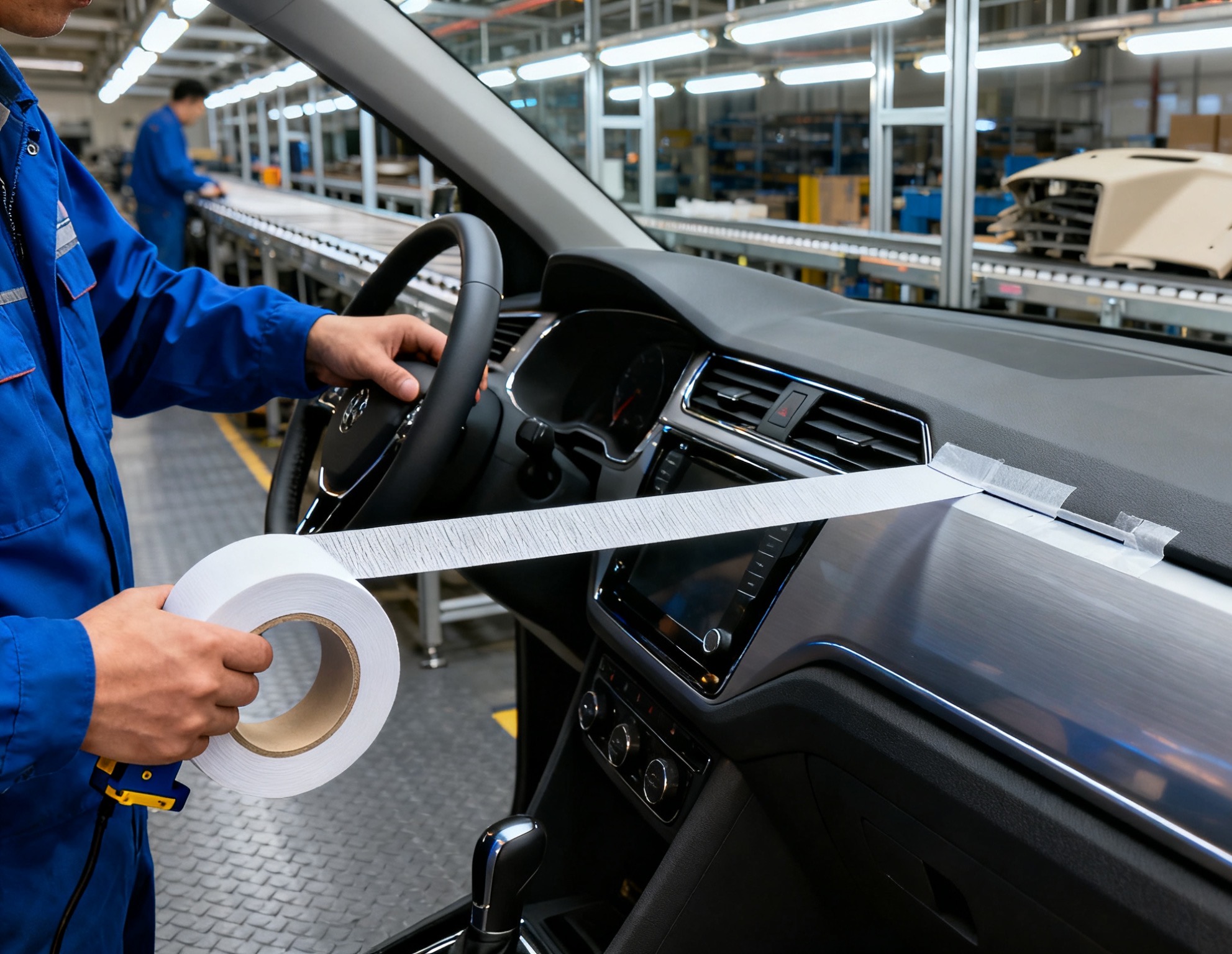
Case 1: Automotive manufacturing and harness fixation
Task: Securing electrical wiring in the engine compartment of a car. Conditions: temperatures up to +120°C, constant vibration, exposure to oils and fuel.
Solution: Use reinforced acrylic tape with a high thickness of the adhesive layer (at least 0.35 mm) and a base made of durable viscose.
Result: The tape ensured reliable fixation of the harnesses, preventing them from rubbing against the body. Vibration resistance made it possible to avoid contact breaks. An attempt to use a cheaper analogue would lead to the fact that the glue would melt at the first serious overheating of the engine, causing a short circuit. Savings are unacceptable here, since the safety of the vehicle is at stake.
Case 2: Construction and installation of floor coverings
Task: Fixing carpets and linoleum in office premises without the use of nails or liquid adhesives. Conditions: pedestrian traffic, the need for quick installation and the ability to dismantle without damaging the floor.
Solution: Specialized fabric-based carpet tape with moderate adhesion allowing clean removal.
Result: Installation took 3 times less time compared to traditional methods. The coating lies flat, without waves. If it is necessary to replace the coating, the tape is removed without leaving any marks on the screed. In this case, it was important to find a balance between holding power and cleanliness of removal. An adhesive that was too strong would make removal impossible without damaging the floor, while an adhesive that was too weak would cause the carpet to move.
These examples show that there is no “universal best tape.” There is a tape that is best suited for your specific application. Before purchasing a large batch, conduct pilot testing on a real site. Apply the tape, create a load, wait 24-48 hours and evaluate the result. This is the only way to ensure that the product meets your expectations.
Also consider the human factor. The tape should be easy to use for your installers. It should unwind easily, be easily torn off by hand (if this is provided for by the design) and not stain your hands with glue. The ergonomics of the workplace affects the speed and quality of assembly. Cheap tape that constantly gets tangled or breaks crookedly slows down work and irritates staff, ultimately reducing overall productivity.
Logistics, certification and working conditions with the manufacturer
When ordering double-sided fabric tape directly from the manufacturer, it is important to consider not only the price of the product, but also the delivery conditions, which can significantly affect the final cost. The minimum shipment quantity (MOQ) is usually from 50 to 100 rolls of one size. Ordering smaller quantities often incurs a line changeover surcharge or increased logistics costs. Plan your needs in advance to consolidate orders and get the best price.
Production times depend on the plant’s load and the availability of raw materials in the warehouse. Standard items are often available to ship within 3-5 business days. Custom orders (custom width, logo printing, special adhesive requirements) may require 2 to 4 weeks. In 2026, supply chains are more predictable than in previous years, but delays are still possible due to customs procedures or seasonal demand. Always build a time buffer into your delivery schedule.
As for certification, to work in the market of Russia and the EAEU countries, it is mandatory to have a declaration of conformity with the CU TR. For specific industries, additional certificates may be required: fire certificate (for construction), hygienic certificate (for food industry), UL certificate (for export to the USA). A responsible manufacturer has a complete package of documents and is ready to provide copies upon request. Lack of certificates means the risk of fines and confiscation of goods at customs.
Packaging plays an important role in the safety of goods. The tape must be supplied in individual boxes or shrink film to protect it from dust and moisture. Palletizing must be done efficiently to prevent the rolls from moving during transportation. Damage to the ends of the roll can render the entire batch unsuitable for use in automatic lines. Check the condition of the cargo upon acceptance and record any damage in the report.
Experience of Enping Sunli Adhesive LLC: Quality guarantees from a manufacturer with a 23-year history
In a world where the risks of counterfeit and unstable raw materials are higher than ever, choosing a trusted partner becomes critical.Enping Sunli Adhesive LLCis not just a supplier, but a professional manufacturer of adhesive tapes with experience since 1997. In 23 years, we have gone from a local factory to an international player specializing in the development and production of high-quality adhesive materials for industry, construction and the domestic sector.
Our approach to quality is confirmed by international standards: production is certified according to quality management systemsISO 9001:2008and environmental managementISO 14001. This means that each batch of our products, be it classic Double Side Tissue Tape, tapes based on PET, PE Foam, EVA foam or innovative nano-magnetic and VHB tapes, undergoes strict multi-stage control. We understand what was said in the previous sections of the article: glue stability, honest thickness and compliance with the stated characteristics are not marketing, but our daily practice.
Our range covers all key market needs: from Finger Lift Tape and Pre Tape Masking/Washi Film to Duct tape and paper-based solutions (Kraft). Sunly Adhesive products are successfully used in the most demanding industries: automotive (fixing harnesses, sound insulation), furniture production, construction and packaging. Thanks to our own scientific and technical center, we offer flexible solutionsOEM/ODM: We adapt the size, type of base and adhesive formula to the specific needs of the client, ensuring an ideal price-performance ratio.
We work according to a transparent pricing system. The price you see in the price list is final, subject to the conditions of shipment volume. No hidden fees or surprise surcharges. We value long-term partnerships and are ready to discuss individual conditions for regular customers, including deferred payment and reserving warehouse capacity for your needs.
Frequently Asked Questions
What is the minimum order quantity for double-sided fabric tape?
The minimum quantity depends on the type of product. For standard items (widths 12mm, 19mm, 24mm, 36mm, 48mm), the minimum order is 1 box (usually 36-72 rolls depending on size). For non-standard cutting or individual printing, the minimum batch is calculated individually and can range from 100 linear meters. At Enping Sunli Adhesive LLC, we try to be flexible and can offer trial samples before placing your main order to ensure you are satisfied with the quality.
Is it possible to get samples before purchasing a large batch?
Yes, we provide free samples of standard products for testing. You only need to pay the cost of delivery by courier service. For individual developments, it is possible to produce a prototype within 3-5 days. This is standard practice and allows you to avoid mistakes when choosing a material. We are confident in the quality of our products, produced on ISO certified lines, and welcome rigorous testing.
What is the shelf life of fabric adhesive tape?
Subject to storage conditions (temperature +15...+25°C, humidity 40-60%, in original packaging away from direct sunlight), the shelf life is 12 months from the date of production. After opening the package, it is recommended to use the tape for 3-6 months to maintain optimal adhesive properties. Storage in unsuitable conditions can lead to the glue drying out or, conversely, to its migration.
Is your tape suitable for outdoor use?
For outdoor use, we recommend only acrylic adhesive tapes manufactured by Sunly Adhesive. They are resistant to ultraviolet radiation, moisture and temperature changes. Rubber-based tapes are not suitable for constant use outdoors, as the glue quickly degrades under the influence of the sun. Please check with our manager for a specific brand of tape certified for outdoor use to ensure the durability of the connection.
Is it possible to put my logo on the ribbon?
Yes, we offer the service of printing a logo or text on a protective layer of tape (liner) or directly on a fabric base (depending on the technology). The minimum print run is usually 500 meters. This is an excellent solution for product branding or cable marking. The production time for a batch with printing increases by 7-10 working days. Contact us to discuss the layout and cost estimate.
Final summary and next step
Choosing a double-sided fabric tape supplier in 2026 is a strategic decision that impacts the quality of your final product and your brand reputation. Cheap tape can be an expensive mistake if it doesn't meet your production specifications. We've provided you with the tools to analyze everything from understanding differences in adhesive formulations to incoming quality control methods. Use this knowledge to negotiate with suppliers on an equal footing and demand documented performance evidence.
CompanyEnping Sunli Adhesive LLCis ready to become your reliable partner in the supply of industrial consumables. With 23 years of experience and state-of-the-art production facilities, we don't just sell tape, we offer engineering support and quality assurance backed by ISO certifications and years of successful operation in the global market. Our goal is for you to forget about problems with fasteners and focus on growing your business.
Do not put off resolving the quality issue until later. Request a commercial offer right now with current prices and delivery conditions for your region. Our specialists will help you choose the optimal brand of tape for your needs and provide free samples for testing.Contact us todayto discuss the details of cooperation and receive a personal discount on your first order. Remember that a reliable connection starts with the right choice of materials.
For more information about our products and services, visitindustrial adhesives and tapeson our website, where you will find complete technical specifications and application cases.